
The net credit card additions in the banking sector nearly halved to 2 million in the first quarter of the current financial year (Q1FY25) from the previous quarter due to seasonal and regulatory factors. According to the Reserve Bank of India (RBI) data, the net credit card additions during the April-June quarter of FY25 stood at 2 million, 48 per cent lower than 3.9 million in the December-March quarter of FY24.

Among Sensex firms, Eternal, Infosys, Asian Paints, HDFC Bank, Bajaj Finserv and Titan were the major gainers. However, Tata Steel, Tech Mahindra, Adani Ports and Bharat Electronics were among the laggards.

Sashidhar Jagdishan, managing director and chief executive officer of HDFC Bank, the largest private-sector lender of the country, has just completed his first term. The period October 2020-October 2023 was a roller coaster, and the second one, which started on October 27, could be more interesting as the lender absorbs the impact of the merger of HDFC, which was integrated on July 1, and moves to the next growth phase. Soon after he took over the reins from Aditya Puri on October 27, 2020, the Reserve Bank of India (RBI) debarred HDFC Bank from enrolling new credit card customers and launching new products under the Digital 2.0 programme due to repeated outages on its mobile-banking and internet-banking platforms.

Credit-to-deposit (CD) ratio of major public sector and private sector banks during the October-December quarter of FY24 inched up as compared to the previous quarter though government-owned lenders reported a lower rate than their private peers. CD ratio is the ratio of the funds that banks lend as compared to the funds raised in the form of deposits. The CD ratio of top public sector banks (PSBs) - State Bank of India, Punjab National Bank, Bank of Baroda and Canara Bank - was lower than their private counterparts.

Bad loans in the agriculture sector remain elevated, with several public-sector banks (PSBs) reporting higher slippages in the April-June quarter of FY26. For many banks, non-performing assets (NPAs) in farm lending were 5 per cent or more, with some nearing double digits.'
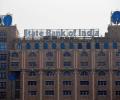
Country's largest lender State Bank of India (SBI) is looking to be among 10 top global banks in market capitalisation terms in the next five years, chairman CS Setty said on Wednesday. "The scope for value creation for the stakeholders is potentially very high. So the larger ambition is if the market supports whether we can be part of the top 10 global banks in terms of the market capitalisation (five years)," he said after listing of shares issued under Qualified Institutional Placement (QIP) at NSE.

While a giant, it's a nimble-footed one, and is growing at a speed that even some of its private sector peers find enviable.
Between FY18 and FY24, it doubled its balance sheet. Despite being a late entrant in some segments, it has been able to grab market share, observes Tamal Bandyopadhyay.

'If we want faster growth and want greater flow of credit towards the private sector, it's important to have many more of such large entities.'

HDFC bank and Reliance Communications have launched India's first virtual credit card. HDFC credit card users can use their Reliance mobile phones to make payments.

The US' move to raise the tariff on most Indian goods to 50 per cent could drag India's GDP growth for FY26 by 35 to 60 basis points, according to various economists. One basis point (bp) is equal to 0.01 per cent.

To increase the adoption of credit on United Payments Interface (UPI), National Payments Corporation of India (NPCI) is looking at an interchange fee for transactions lower than that for a credit-card transaction. Sources in the know said these charges could be 1-1.2 per cent. Fintech participants concur with the view that the interchange fee is expected to be lower than that for a credit-card transaction.

Ask rediffGURU and PF expert Nitin Narkhede your mutual fund and personal finance-related questions.
The country's largest private lender HDFC Bank on Saturday reported a 6.51 per cent decline in its consolidated net profit to Rs 16,474.85 crore in the April-June quarter compared to the previous January-March quarter. The city-headquartered lender, which merged its mortgage major parent HDFC into itself in July last year, had reported a net profit of Rs 17,622.38 crore in the March quarter. On a standalone basis, the net profit declined to Rs 16,174.75 crore in April-June 2024-25 from Rs 16,511.85 crore in January-March 2023-24.
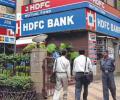
But there are challenges, observes Tamal Bandyopadhyay.

GST 2.0 may cushion consumers against US tariffs, but like the 2019 corporate tax cut, it risks being another tactical fix rather than a structural growth strategy, expects Debashis Basu.
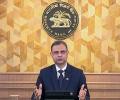
Mixed views were expressed by top economists on the Reserve Bank of India's (RBI) Monetary Policy Committee's (MPC) decision to hold the repo rate at 5.5% and maintain a neutral stance. While some say the decision was as expected and one more rate reduction is expected this fiscal, there is also a view that rate cut by MPC was warranted given the evolving global situation.
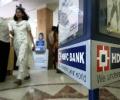
The bank has about six million credit card customers.
With the merger between HDFC Bank and HDFC Ltd complete, analysts said the next key monitorable for the Street would be successful resolution of merger-related hiccups, including employee-related churn and roll out of complete banking services across branches. At the bourses, they expect the stock to perform in-line with the benchmark indices in the near-term. "There's usually an initial period of consolidation after a merger as the entities work towards integration.

With high credit growth and healthy asset quality, listed commercial banks are expected to report steady growth in earnings during the fourth quarter ended March 2024 (Q4 FY24). Profits are expected to grow at 9.6 per cent year-on-year (Y-o-Y) and net interest income (NII) by 8.7 per cent in Q4 FY24, according to Bloomberg analysts' estimates. According to Motilal Oswal Securities, while bank credit growth has been robust, deposit growth has also gathered pace.

Securitisation - sale of loans to investors - by lenders, including banks and non-banking financial companies (NBFCs), crossed Rs 50,000 crore during the fourth quarter ended March 2025 (Q4F25). This is a tad higher than Rs 48,000 crore during the same period of FY24.

The banking regulator was uncomfortable with the runaway pace at which consumer credit was growing.

The Reserve Bank of India's (RBI) Monetary Policy Committee's (MPC) decision to cut the repo rate by 50 basis points (bps) to 5.5% was contrary to the expectations of many economists. Firstly, most of the economists expected the MPC to cut the repo rate by 25 bps citing the weakening of inflation, prospects of economic growth, geopolitical uncertainty and comfortable system liquidity.

HDFC Bank, the country's largest private-sector lender, lost to competition wholesale loans of around Rs 50,000 crore after it increased interest rates in May, said Chief Financial Officer Srinivasan Vaidyanathan in an analyst call. "There were some customers who were offered lower rates by other market participants. "But we decided not to cut back on our rates," he said while addressing analysts after the announcement of the bank's Q1 earnings.
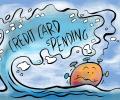
Credit card spending dropped 11 per cent sequentially in November at Rs 1.15 trillion, but topped Rs 1 trillion for the ninth month straight, data from the Reserve Bank of India (RBI) showed as the festive season ends and consumption activity slows down. Year-on-year (YoY), spending was up 29 per cent. Card spends have consistently topped the Rs 1 trillion mark, led by the rising share of e-commerce transactions.
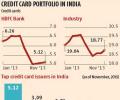
Lender had 5.12 mn cards - almost a third of the total number of credit cards in the industry - at the end of November, 2013.
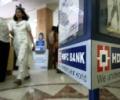
Currently, customers outside the bank's existing client base account for 25 per cent of its card base.

The bank has said rent payments will not earn reward points, and redemption of reward points on various cards have been capped in certain segments.
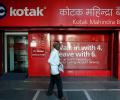
Cracking down on repeated non-compliance of IT norms, the RBI on Wednesday barred Kotak Mahindra Bank from onboarding new customers through its online and mobile banking channels and issuing fresh credit cards with immediate effect after the regulator found "serious deficiencies" in the lender's IT risk management. These actions, the RBI said, are necessitated based on significant concerns arising out of Reserve Bank's IT examination of the bank for the years 2022 and 2023 and the continued failure on part of the bank to address these concerns in a comprehensive and timely manner.
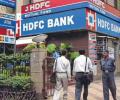
This will be the lender's first result after its merger with HDFC Ltd, effective from July 1, and will keep analysts glued to the management's earnings growth guidance for the merged financial behemoth.
HDFC Bank has partnered with National Insurance Company and Mastercard International to launch its "HDFC Bank Health Plus Credit Card" and expects to sell 15,000-20,000 cards in the first year of the alliance.
Credit card spends in June, although down marginally month-on-month (MoM), remained above the Rs 1-trillion mark for the fourth consecutive month. In June, credit card spends topped Rs 1.09 trillion, down 4.34 per cent MoM, revealed the data released by the Reserve Bank of India (RBI). However, on a year-on-year basis, spends were up 73 per cent. In May, credit card spends hit an all-time high, reaching Rs 1.14 trillion.
The country's largest housing finance company HDFC Ltd will merge with the country's largest private sector lender HDFC Bank, according to a regulatory filing. The scheme of amalgamation will be subject to various regulatory approvals, including from the Reserve Bank of India (RBI) and the Securities and Exchange Board of India (Sebi), HDFC Bank said in the filing on Monday.

After a sharp fall in the share prices of HDFC Bank and other private sector lenders in the past three days, the BFSI (banking, financial services and insurance) sector weighting in the Nifty50 has slipped to a seven-year low of 32.03 per cent, down from nearly 36.6 per cent at the end of March 2023 and 34.5 per cent at the end of December 2023.
The Reserve Bank of India is likely to take a call on the relaxations sought by HDFC Bank in relation to the merger, as the date of merger draws closer, sources said. The HDFC twins, which announced their decision to merge in April last year, received National Company Law Tribunal's (NCLT's) approval recently - a key milestone to close the deal in due time. The management of both the entities had said that it will take 15-18 months for the merger.
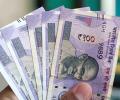
One should avoid keeping excessive funds in one's savings account.

Despite rising interest rates, leading home loan players SBI and HDFC have announced discounted interest rates beginning at 8.40 per cent as part of their festive offerings. SBI in a statement said that its home loan book has topped the Rs 6 lakh crore mark, a first in the industry. The leading lender said it is offering up to 25 bps discount on interest rate to new home loan borrowers, making the entry level rate at 8.40 per cent and the offer will run up to January 31, 2023.
Kotak Mahindra Bank's net interest margin is likely to swell after the Reserve Bank of India (RBI) lifted its restrictions on the private lender that barred it from issuing fresh credit cards and onboarding new customers through digital mode, brokerages said on Thursday. The bank's net interest margin (NIM) has seen a decline of over 35 basis points (bps) since the restrictions were imposed by the regulator in April 2024.

Highly-rated finance firms and housing finance companies are expected to benefit from the absence of Housing Development Finance Corp (HDFC) from the bond market once it merges with the HDFC Bank in early FY24. Post merger, the bond market is expected to become less crowded, which will ease fund raising conditions for other players in the field. It may perhaps also compress the spread for debt instruments floated by housing finance companies (HFCs) over 10-year government bonds, subject to demand and supply conditions.
